Two colleagues talk while walking outside an office building.
Cordant Counterparties

Hold every counterparty to the agreement it signed

Compare what partners, processors and vendors actually do against the terms you agreed to.
Request a demo

Recover missed revenue

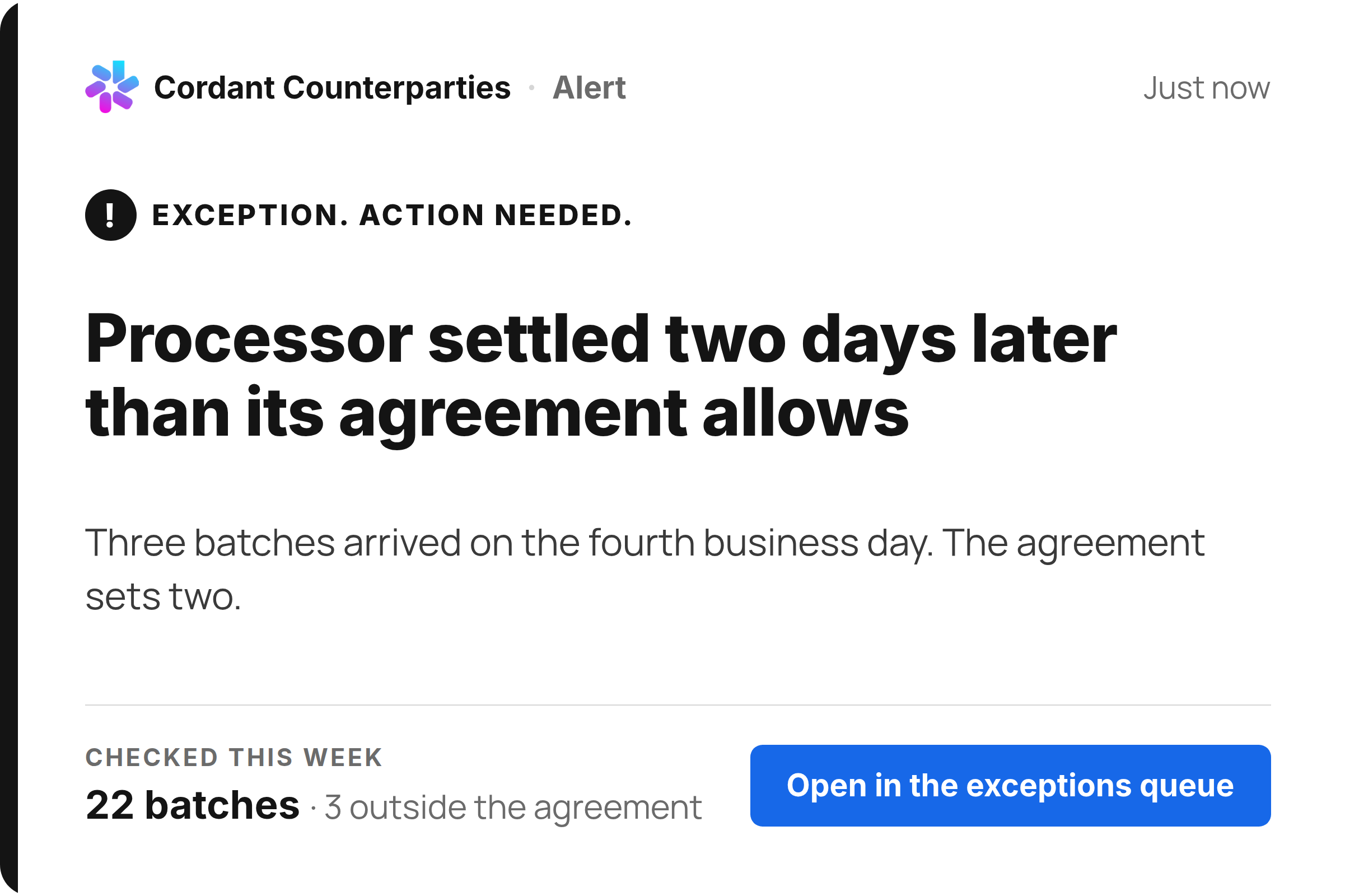
Cordant Counterparties flags three settlement batches arriving two days later than the agreement allows.
Know when a counterparty stops operating within the agreement.
Checks:
  • Agreement rules. Turn partnership, program and sponsorship agreements into traceable checks.
  • Partner drift. Flag activity that moves outside agreed terms.
  • Parameter limits. Check volume, geography and approved providers against contractual limits.
  • Merchant certifications. Identify merchants operating with expired required attestations.
Catch fees, invoices and payouts that do not match the deal.
Checks:
  • Fee validation. Check processor and network fees against contracted pricing and interchange.
  • Invoice matching. Compare invoices with pricing tiers, rebates and service penalties.
  • Settlement terms. Check settlement amounts and timing against the agreement.
  • Residuals and commissions. Validate payouts against the agreement that governs them.
  • Revenue recognition. Compare recognized revenue with billing, settlement and customer terms.
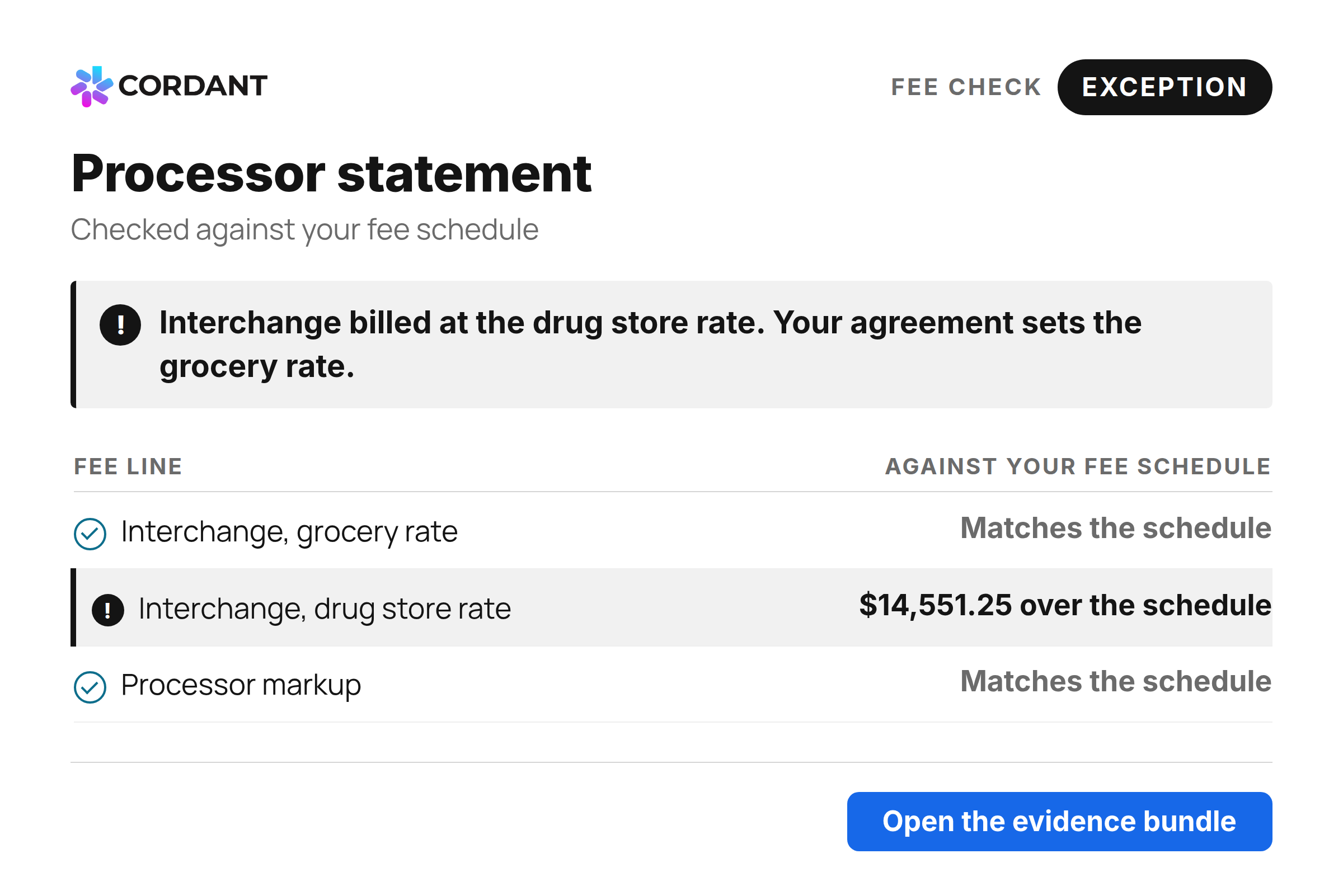
Cordant Counterparties identifies a processor interchange charge above the contracted fee schedule.
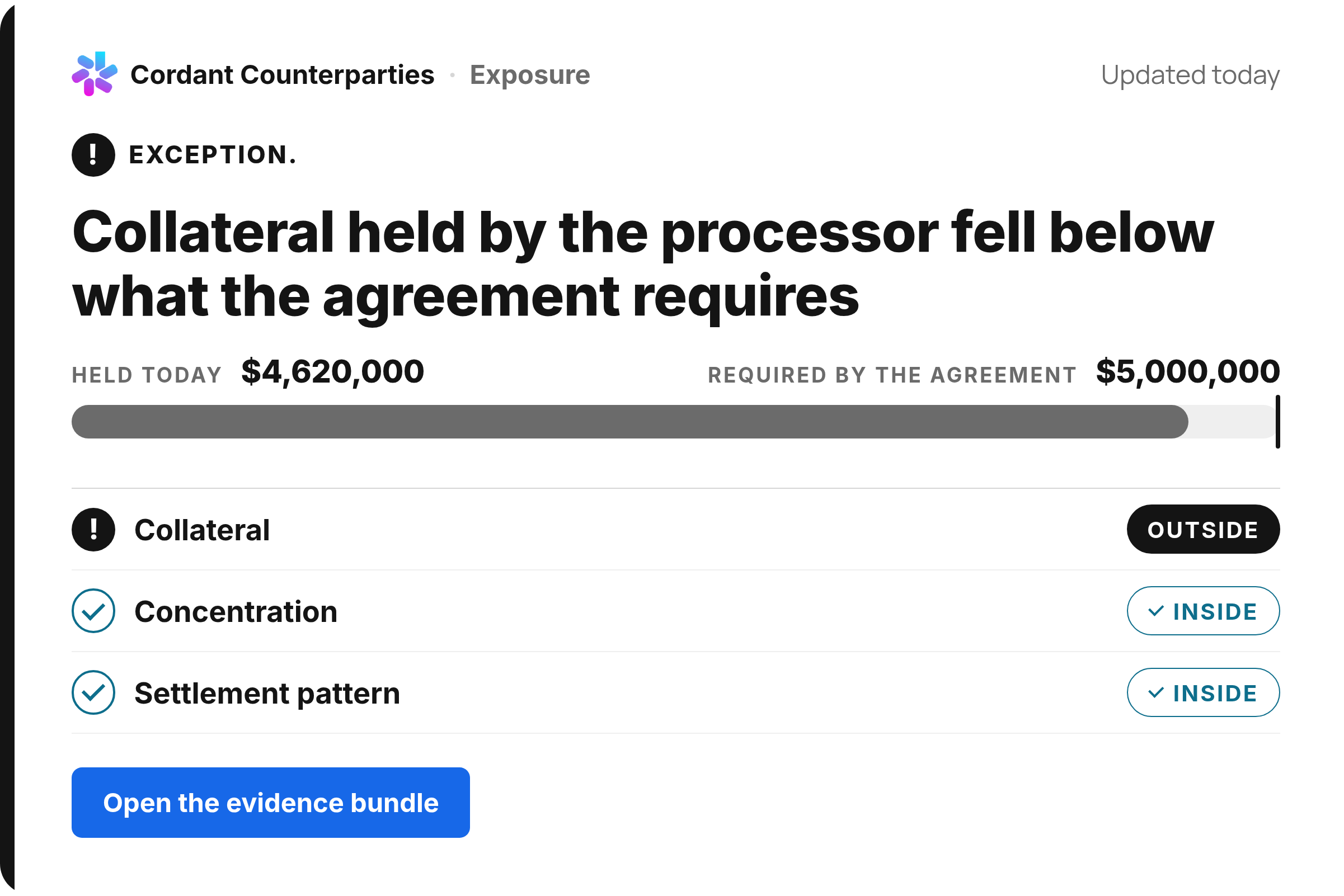
Cordant Counterparties flags processor collateral below the balance required by the agreement.
See counterparty exposure move before it becomes a bigger problem.
Checks:
  • Collateral adequacy. Check balances against custody, funding and counterparty requirements.
  • Distress signals. Flag settlement and volume patterns moving outside agreed thresholds.
  • Concentration limits. Track exposure to each partner, program and provider.
  • Evidence bundles. Give the team the records and contract language needed to investigate, escalate or recover money.

Start  recovering lost revenue.

Request a demo
24-hour cycle icon.
Agreement rules
Turn signed terms into checks that trace back to the exact clause.

Broken chain link.
Partner drift
Catch activity that moves outside agreed limits, regions or providers.
Rising bar chart.
Service levels
See when processors, sponsors or providers miss contractual commitments.
Interlocking gears.
Fee validation
Find overcharges, misclassified transactions and pricing errors.
Coins with a dollar symbol.
Invoice matching
Check invoices, rebates, penalties and billed amounts against contracted pricing.
Dollar symbol with a gear.
Residuals and commissions
Validate payouts before money leaves.
Pie chart.
Concentration limits
Track exposure to partners, programs and providers against your limits.
Interlocking puzzle pieces.
Evidence bundles
Give every exception the transaction history, supporting records and contract clause behind it.
What partner and finance leaders tell us

These are the problems teams are trying to solve today.

“
I only manage five programs because I don't have the operational capacity to manage more. Give me the oversight and I'll manage fifty.

Head of Partner Management

“
We paid the processor as invoiced. The overcharge and the misclassified interchange surfaced at board prep, months late.

Head of Finance

“
Our processor missed its settlement window. The first person to know was our merchant.

Head of Payments

Cordant Counterparties

Stop finding contract problems after they have already cost you.

Request a demo
frequently asked questions
Short answers to the questions that come up first.
Does Cordant Counterparties replace our partner management, third-party risk or reconciliation system?
Chevron down icon
No. Keep the systems you already use to manage relationships, risk and reconciliation.

Cordant adds a different check: does what actually happened match the agreement that governs it?
What does Cordant Counterparties check against?
Chevron down icon
Any agreement between your institution and a third party, including partnership and program agreements, sponsorship agreements, processor contracts, service levels, vendor contracts, merchant agreements, fee schedules, agent agreements, custody agreements and funding terms. Cordant Controls handles internal policies and regulatory requirements.
Which parties does Cordant Counterparties cover?
Chevron down icon
Any party you have an agreement with, including processors, sponsor banks, vendors, providers, programs, merchants, independent sales organizations, clients, agents and employees receiving contractual payouts.
What is the difference between Cordant Counterparties and Cordant Controls?
Chevron down icon
Counterparties asks: did the other party do what it agreed to? Controls asks: did your institution do what its own policy or regulatory requirement says? A processor charging more than its fee schedule allows is a Counterparties exception. An internal screening step your policy required but your team missed is a Controls exception.
Where does Cordant Counterparties get its data, and where does our data go?
Chevron down icon
From the systems where the activity actually happened, including processor files, settlement records, ledgers, billing systems and payout systems. Connections are read-only through APIs, webhooks or file drops.
How does Cordant Counterparties turn a contract into rules, and can we trust them?
Chevron down icon
Cordant turns contractual terms into rules that trace back to the clause they came from. If the systems show one thing and the contract says another, Cordant surfaces the difference with the supporting evidence so your team can decide what needs to change.
Is Cordant Counterparties a standalone product?
Chevron down icon
Cordant Counterparties runs on the Cordant Command Center. The Command Center connects to your systems read-only and creates the operating view Counterparties uses to compare actual activity with your agreements.