A man looks thoughtfully across an office.
Cordant Controls

Know when money moves outside the lines

Cordant Controls provides proof your institution did what it committed to whenever the examiner, the sponsor or the network asks.
Request a demo

Coverage, evidence and mandates, checked on every transaction instead of once a quarter.

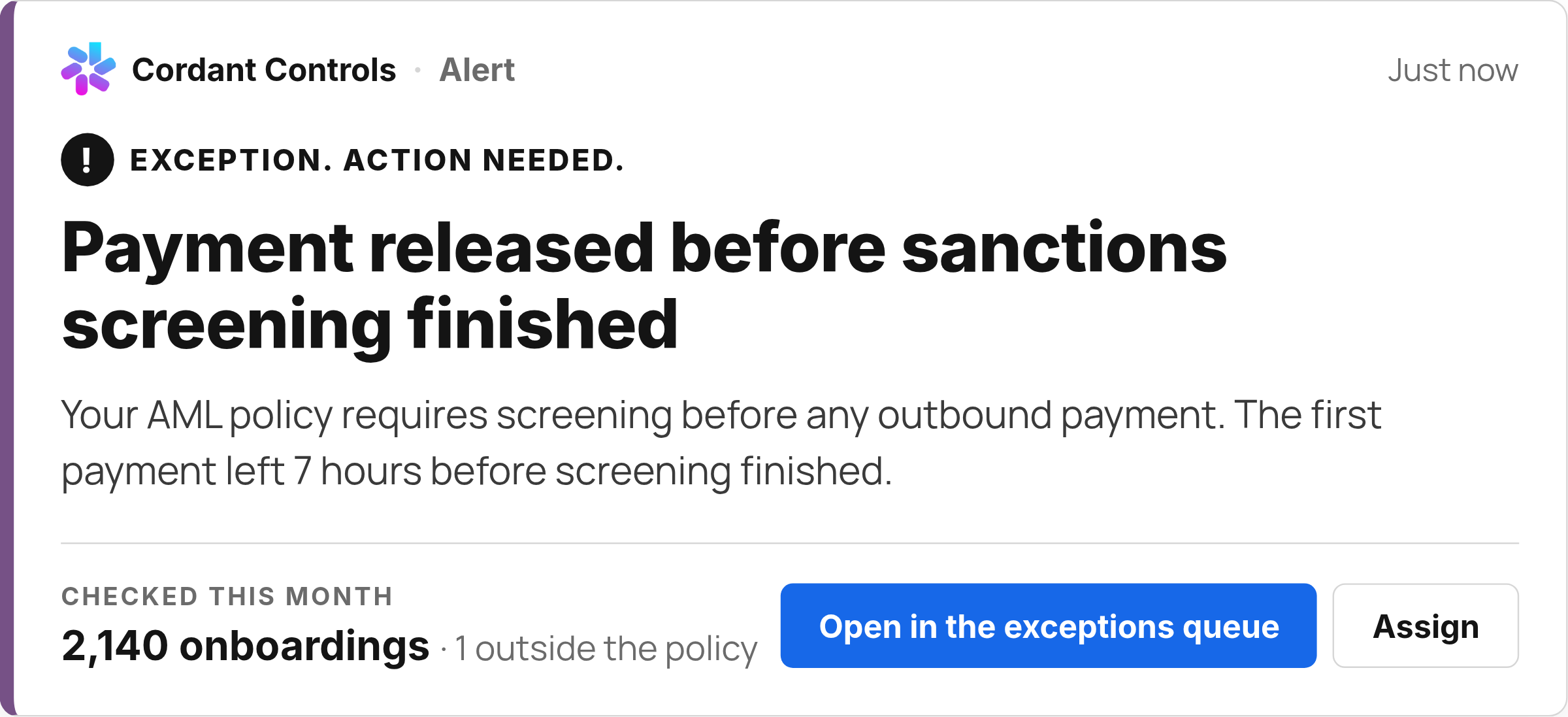
Cordant Controls flags a payment released before sanctions screening finished.
Turn each policy, mandate and procedure into a rule that gets checked.
includes:
  • Screening and KYC checked against the timing your policy sets, before the account or transaction proceeds
  • Escalations checked against your escalation policy: did it happen, and did it happen in time
  • The rails and flows no control is watching, named
  • Every rule traced to the clause it came from, in a document with your institution's name on it
Assemble exam-ready evidence as the work happens.
includes:
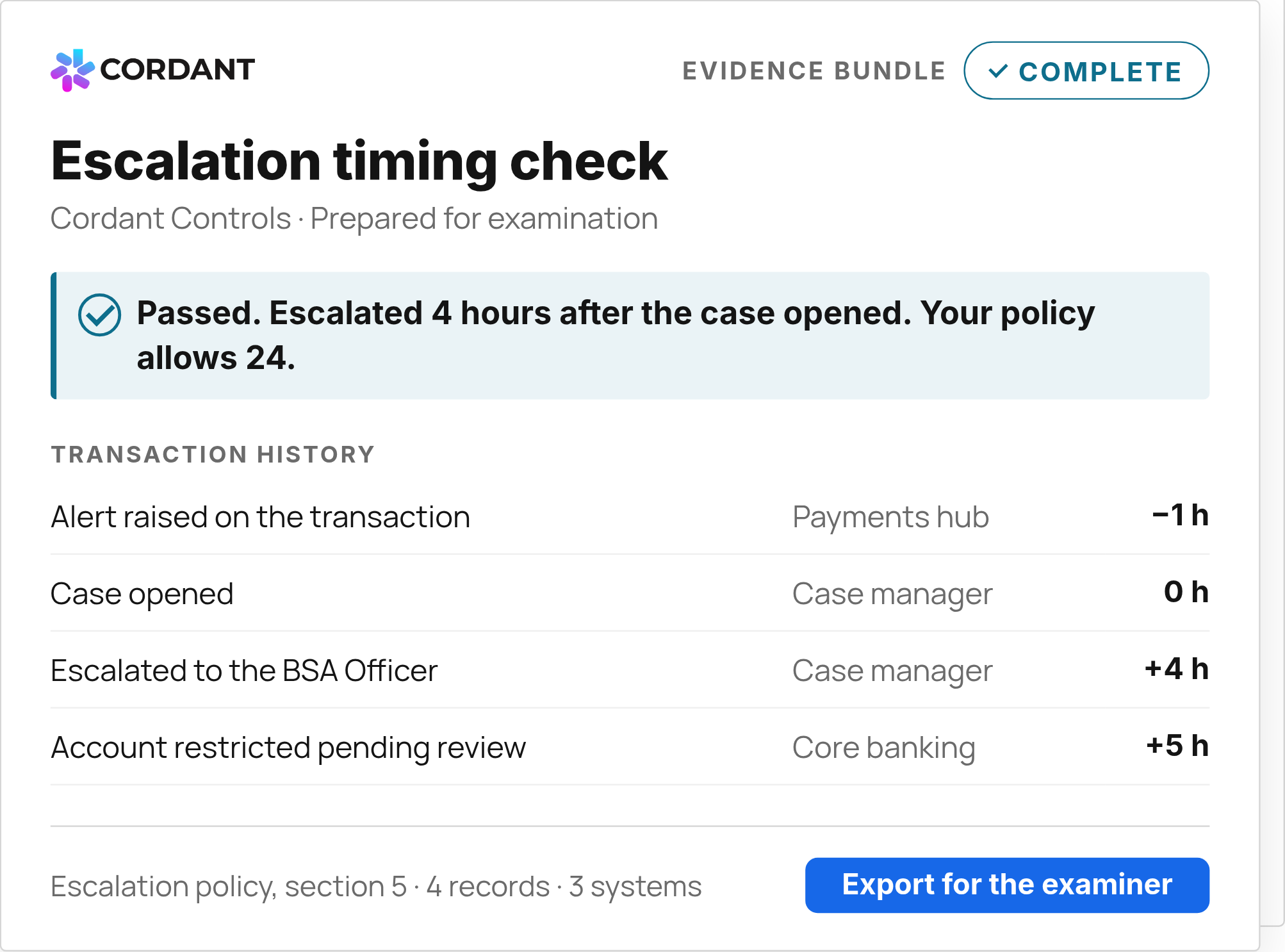
  • Audit-grade evidence assembled for every check, as the work happens
  • The transaction's full history across systems, the records and the policy clause, in one bundle
  • Extractable in the form the examiner or internal audit asks for
  • Continuous and complete, in place of quarterly samples
Cordant Controls evidence bundle traces an escalation completed four hours after a case opened, within the 24-hour policy.
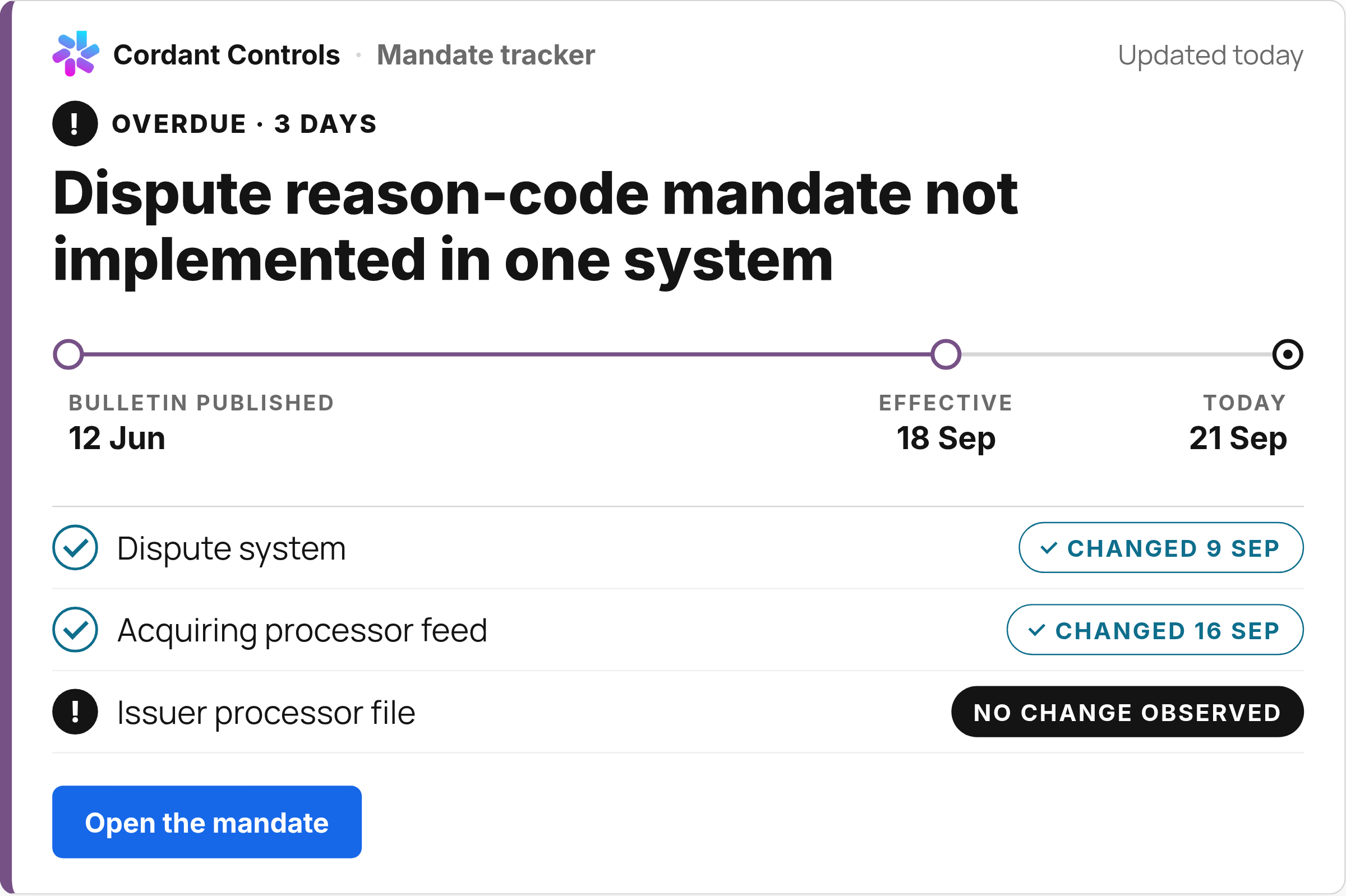
Cordant Controls flags an overdue mandate that has not been implemented in the issuer processor file.
Track mandates and procedures against what your systems did.
includes:
  • Network mandates tracked from the bulletin to the implementation, by deadline
  • Runbooks, escalation paths and approval chains checked against what happened
  • Rules followed in practice and never written down, proposed for your approval
  • A process map that matches the process, without rebuilding it by hand
What Cordant Control Checks

Every control you promised the examiner, checked every day.

Request a demo
Question mark in a circle.
Policy checks on every transaction
Every event tested against your internal policy, as it happens.

Organizational hierarchy.
Mandate tracking
Custom workflows for vendor payments, expenses, and budget approvals. Everything tracked, nothing delayed.
Stacked coins.
Exam evidence bundle
The transaction's history across systems, the records and the policy clause, extractable when the examiner asks.
Magnifying glass.
Screening and KYC timing
Did screening run, and did KYC complete, before your policy said the account or transaction could proceed.
Crossing arrows.
Coverage gaps, named
The rails and flows no control is watching, called out by name.
People arranged in an organizational hierarchy.
Procedure adherence
Runbooks, escalation policies and approval chains checked against what actually happened.
Interlocking puzzle pieces.
Always-on audit
Continuous, complete evidence in place of quarterly samples.
Person with a question bubble.
Every gap, with an owner
Each gap arrives with the cause, the system carrying it and the person who owns the fix.
Customer perspectives

What Compliance leaders tell us

“
Exam prep is three weeks of my people assembling evidence by hand, every time, for a question we knew was coming.

Head of Compliance

“
We check a sample because checking all of it would take the whole team. Then the auditor asks about the ones we did not check.

Head of Internal Audit

“
The mandate took effect in March. Whether we had implemented it, we found out in the audit.

Chief Compliance Officer

Cordant Controls

Know  when the operation leaves the rulebook.

Request a demo
frequently asked questions
Short answers to the questions compliance, risk and audit leaders ask on a first call.
Does Cordant Controls replace a compliance engine, case manager or GRC system?
Chevron down icon
No. Cordant Controls does not replace your compliance engine, case manager or GRC system. The case stays in your case manager, the policy stays in your GRC system, and your monitoring engine keeps running.

Controls reads what each of them concluded and checks it against your policy, so it can tell you whether the engine ran on everything your policy said it should, and what nothing is watching. It does not score a transaction, work a case or file a report.
Does Cordant Controls take action in our systems or move money?
Chevron down icon
No. Cordant Controls is read-only. It connects to the systems you already run, writes nothing back, moves no money and holds no funds or production keys. It checks what your systems did against what your policy says should have happened, and hands each finding to the person who owns it, with the evidence attached.
What does Cordant Controls check transactions against?
Chevron down icon
Cordant Controls checks every transaction against documents your institution wrote or has to follow: internal policies, procedures and runbooks, network mandates, regulation and supervisory guidance, exam findings and consent orders, and the standards you adopt. Agreements a third party signed with you, such as a program agreement, a processor's fee schedule or a service level agreement, are checked by Cordant Counterparties.
What is the difference between Cordant Controls and Cordant Counterparties?
Chevron down icon
The document decides. Cordant Controls checks your institution's own conduct against a policy it wrote or a rule it has to follow. Cordant Counterparties checks a third party's conduct against the agreement it signed with you. A screening step taken four days late is a Controls finding, even when the customer is a third party, because the four days come from your own policy.
How does Cordant Controls create its rules, and can we trust them?
Chevron down icon
Every rule in Cordant Controls traces to a clause in a document with your institution's name on it. Where Cordant infers a rule from how your team actually works, it arrives as a suggestion with its evidence attached, and nothing runs until you approve it. Cordant does not benchmark you against best practice. It holds you to your own terms.
Where does our data go when we use Cordant Controls?
Chevron down icon
Your data stays in the systems that hold it. Cordant Controls connects read-only, by API, webhook or file drop, with no schema changes on your side. Only the evidence travels. Every expansion of access is scoped, approved by you and revocable.
Is Cordant Controls a standalone product, or does it need the Cordant Command Center?
Chevron down icon
Cordant Controls runs on the Cordant Command Center, which connects to your systems and reconstructs every transaction across them. Controls adds the check against your own policies and your regulators' rules, and produces an audit-grade evidence bundle for every check: the transaction's history across systems, the records and the policy clause, extractable when the examiner asks.