A man considers his work beside a laptop in an office.
Cordant Command Center

One command center across your financial operations

Cordant connects what happened, what should have happened, and what needs attention across every system and counterparty.

Request a demo

Give AI the context to run your financial operation.

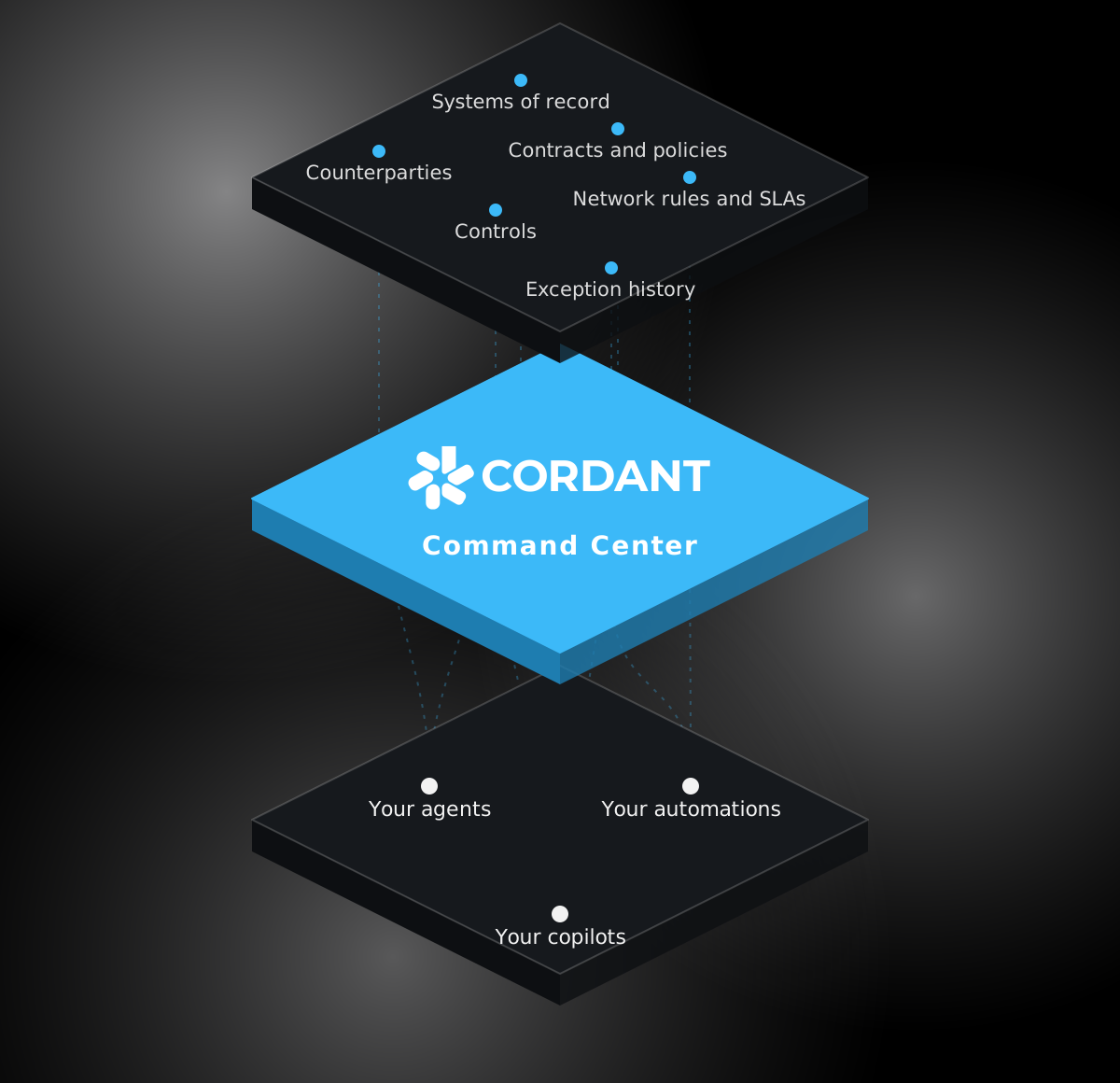
Cordant Command Center connects systems of record, contracts, network rules, counterparties, controls and exception history to agents, copilots and automations.
Connect the systems, rules, and relationships your AI needs to run end to end.
What each agent receives:
  • Ground truth. What happened across every system, and what never happened.
  • The rule. What should have happened, from the contract or policy that set it.
  • The owner. Who picks it up and who approves the fix, from the operating map.
  • The evidence. The records and the clause behind every action, kept as the trail.
  • Guardrails. Read-only first, no production keys, no payment execution, and no outward step without a person approving it.
ONE PLATFORM

One platform. Multiple workflows. The same truth underneath.

Interlocking puzzle pieces.
Full picture
See every payment as one record across every system it touched.
Magnifying glass.
Exceptions
Get every exception as one story: every record the payment left, the system carrying it, and the step where it stopped.
Crossing arrows.
Reconciliation
Match fragmented payment data across every system from day one with ledger-ready outputs.
Check mark.
Audit-ready evidence
Keep evidence assembled continuously, audit-grade, for every signal, whichever product raised it.
Map with a location pin.
Operating map
See how your work actually runs across teams: who picks up, who escalates, who approves.
Rocket.
Fast start
Go live in days, not quarters. Cordant reads what your systems already produce.
Rising bar chart.
Capacity
Stop scaling operations headcount with transaction volume.
Audience inside a target.
Bank grade security
Clear security review during the pilot: single sign-on, multi-factor, role-based access, tamper-proof logs.
Reconcile every rail and every system from day one.
Cordant reconciles every rail and every system, and explains where the records stop agreeing
  • Payment lifecycle. Follow each payment across every system it crossed, start to finish.
  • Balance reconciliation. Check every account, wallet and processor against each other.
  • Close reconciliation. Tie billing, settlement and the ledger together all day.
  • Attestation readiness. Walk into the attestation with the evidence already assembled.
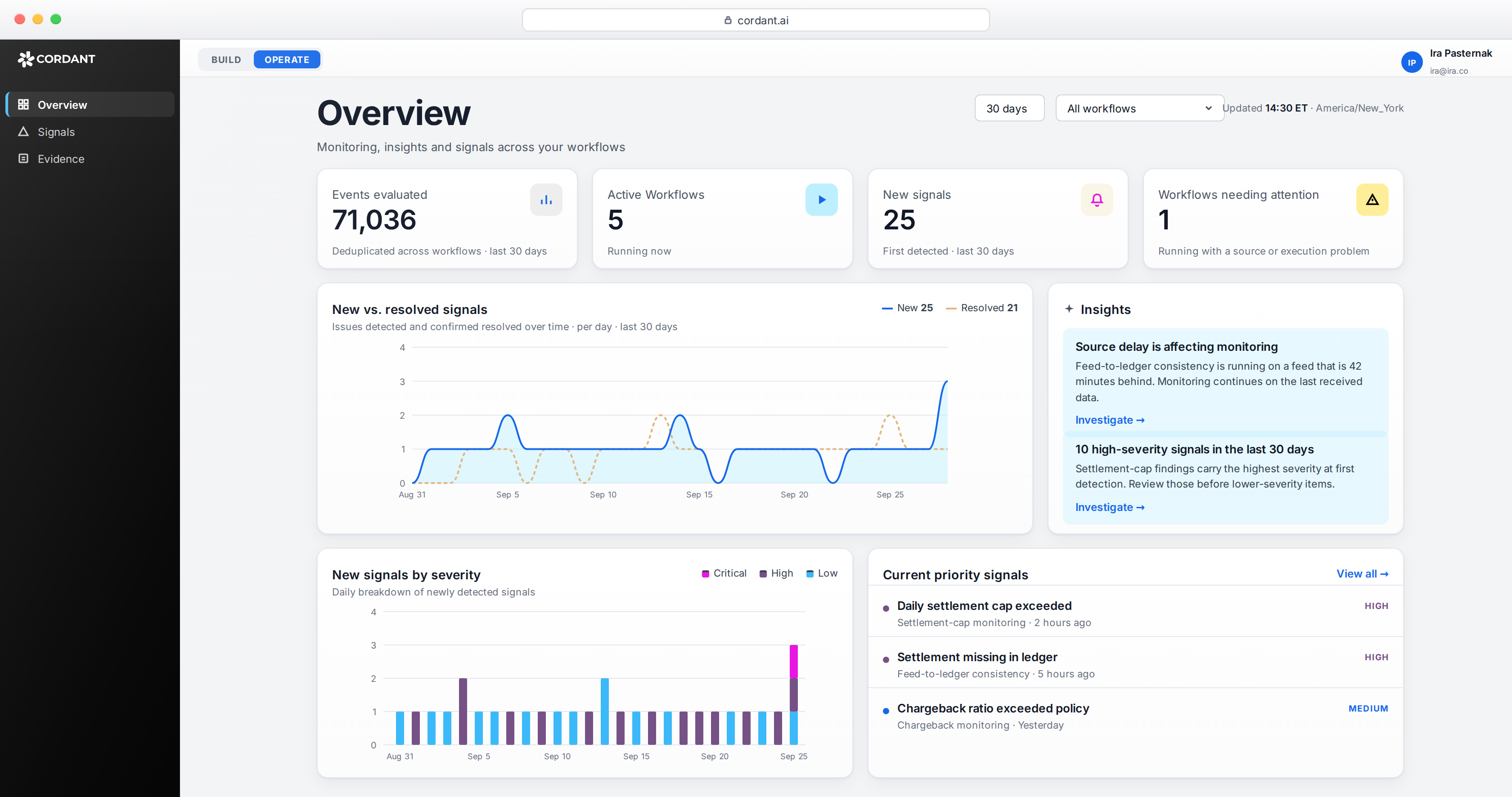
Cordant Command Center dashboard showing payment activity, exceptions and operational insights.
PLATFORM ADVANTAGE

Every answer makes the operating picture better.

Interlocking puzzle pieces.
One record

Every system's version of a payment, read as one story.

Check mark.
One rule set

Contracts, policies and network rules, applied the same way to every transaction.

Calendar checklist.
One evidence trail

Every finding keeps the records and the clause behind it.

Linked chain icon.
No rip-and-replace

Read-only. Your systems stay the systems of record.

Map with a location pin.
Compounding Operating Map

Every resolved exception teaches the map who handles what.

THE OPERATING MAP

Your operation has a map. It just hasn't existed anywhere yet.

Systems know their piece.

Contracts know the terms.

Operators know the exceptions.

Cordant connects them into one living model of how the institution actually operates.
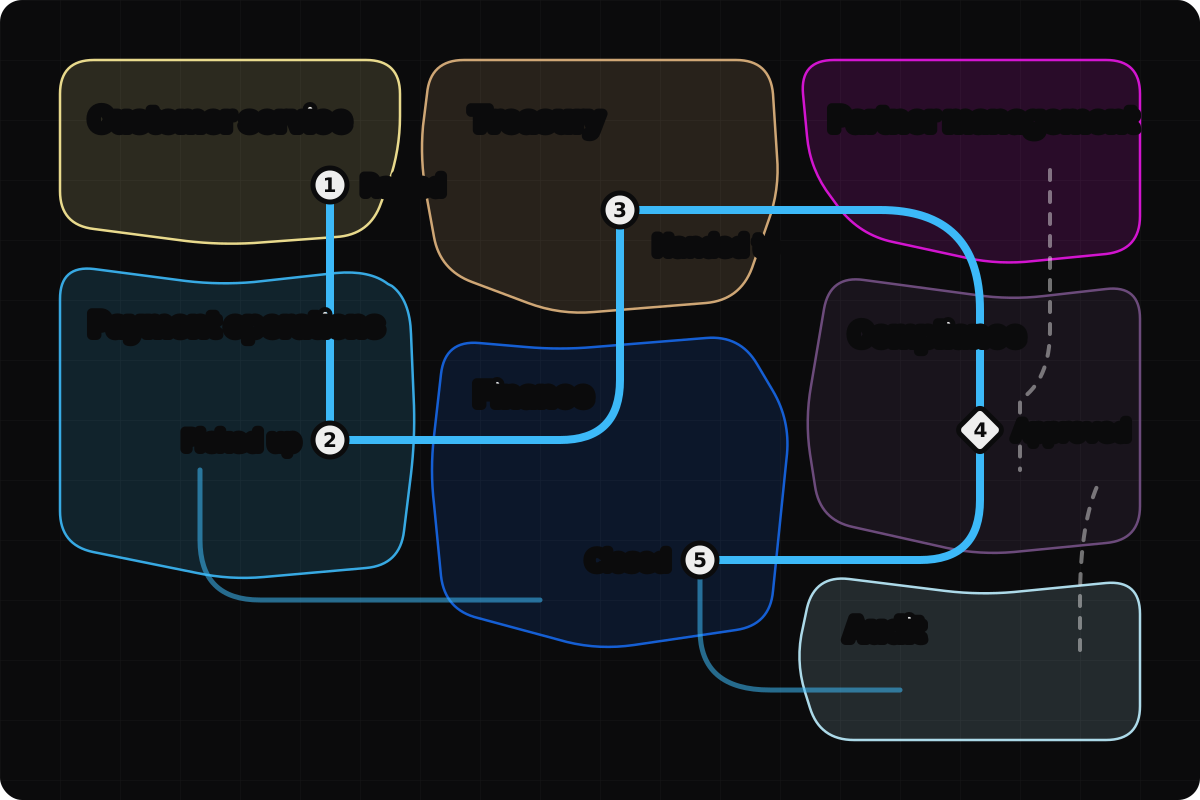
Operating map traces an issue from raised to picked up, handed over, approved and closed across operational teams.
frequently asked questions
Short answers to the questions operating leaders ask on a first call.
Does the Command Center replace our reconciliation tool, ledger or data warehouse?
Chevron down icon
No. Your systems stay the systems of record. The Command Center reads what each of them recorded, joins those records into one story per payment, and shows where they stop agreeing.
What do we get before we add Cordant Controls or Cordant Counterparties?
Chevron down icon
Every payment reconciled across every rail and system, with the step where the records stop agreeing named. It also finds what no system reported: a payment that started and never completed, a file that never arrived, or a record one system sent and another never received. Every exception comes with the evidence and goes to the person who owns it.
Does Cordant move money or take action in our systems?
Chevron down icon
No. The Command Center is read-only. It holds no funds and no production keys, moves no money, and writes nothing back to the systems it reads. That independence is what lets it check every system's work, including its own.
Which systems does it connect to, and how?
Chevron down icon
It connects to banking cores, processors, card networks, ledgers, compliance and KYC tools, custody platforms, on-chain data and file-based systems. Connections are read-only, by API, webhook or file drop, with no schema changes on your side.
Where does our data go?
Chevron down icon
It stays in the systems that hold it. Only the evidence behind each signal travels, and every expansion of access is scoped, approved by you and revocable.
How does the Command Center work with our AI agents?
Chevron down icon
An agent receives the same signal a person does: what happened across every system, who owns it, and the evidence behind it. Guardrails come first: read-only, no production keys, no payment execution, and no outward step without a person approving it.
What is the difference between the Command Center and the two products?
Chevron down icon
The Command Center shows what happened across your systems and where the records disagree. Cordant Controls checks it against your own policies and your regulators' rules. Cordant Counterparties checks it against the contracts you signed.
Can't we build this ourselves?
Chevron down icon
You can read the same contracts and policies Cordant reads. Rebuilding every payment across every processor, bank and ledger you run is a product, not a project. The team that builds it becomes the team that maintains it, every time a rail or partner changes.
How long does it take to go live?
Chevron down icon
Days, not quarters. Cordant reads what your systems already produce, so there is nothing to rebuild or migrate. Guided setup connects each system and confirms data is flowing before the first signal.
Can we load historical data, or only live events?
Chevron down icon
Both. Cordant takes live events and bulk historical files through the same process, so a year of past records gets the same treatment as today's. Large files are split as they are read, so work starts before the whole file has loaded, and duplicate files are caught so nothing is counted twice.
Which AI models does Cordant use, and can we choose?
Chevron down icon
You choose the AI provider your institution has approved, and Cordant never uses a model you haven't enabled. You can also bring your own keys.
Is our data kept separate from other customers?
Chevron down icon
Yes. Each customer's data is held in its own isolated store that no other customer can reach. It is encrypted in transit and at rest, requests from your systems are signed, and you can add your own encryption key on top of Cordant's.
What happens to personal data in our records?
Chevron down icon
Cordant identifies personal data as each record comes in and encrypts it on the spot. Personal data is never sent to an AI model, and every call to a model goes through a single, isolated gateway.
Can we see what Cordant did with our data?
Chevron down icon
Yes. Every step a record takes inside Cordant is logged, from the moment it arrives, including every time it touched an AI model. The log can be searched, so your team or an auditor can trace any finding back to the raw record it came from.
Do we have to connect every system at once?
Chevron down icon
No. Cordant starts with the systems you connect first and adds the rest as each one comes online.
CORDANT COMMAND CENTER

See what Cordant can see across your operation.

Request a demo